What are the Odds of a Droptine?
If you enjoy hunting big whitetails, some of you are probably obsessed with antlers. Not in the sense that you’re some Disney trophy hunter who cares less about the animal and more about the clout that comes along with killing a trophy buck. I’m talking about being obsessed with the uniqueness of each animal and fascinated by how older deer seem to add more and more character as they age.
It had me thinking about one particular antler trait that seems exceptionally rare in whitetails: the droptine.
I’m not necessarily talking about a sticker off the base or a little nub that happens to point downward. I’m talking about an actual tine coming downward off the main beam—let’s call it three inches or longer.
I did a quick search to see if there was any real study on just how rare this feature is, and what I found was fairly inconclusive.
I started running trail cameras sometime around 2007. If I combine trail-camera photos with sightings from the stand and observations from the road over roughly the last 20 years, I can only think of three bucks I had permission to hunt that possessed a true droptine.
If I’ve observed more than 500 individual bucks during that time—and that is a very rough estimate—that would put my personal observation rate at less than one percent. Obviously, if we narrowed it down to mature bucks, say 4½ years old and older, that percentage would rise. But even then, I’d guess a true droptine is still something you see on only a very small percentage of mature bucks.
Gonzo
The most recent one I saw is also one I was fortunate enough to harvest. If you’ve followed any of my posts or spent time on my website, you probably know the story of Gonzo. He was a special deer and ultimately became the pinnacle of my hunting career.
Gonzo was 9½ years old when I killed him and had grown double drops every year after he turned six. Other than one year when he busted one of them off, he carried a droptine on each side.
One of those drops eventually reached around 12 inches.
The Giant 8-Point
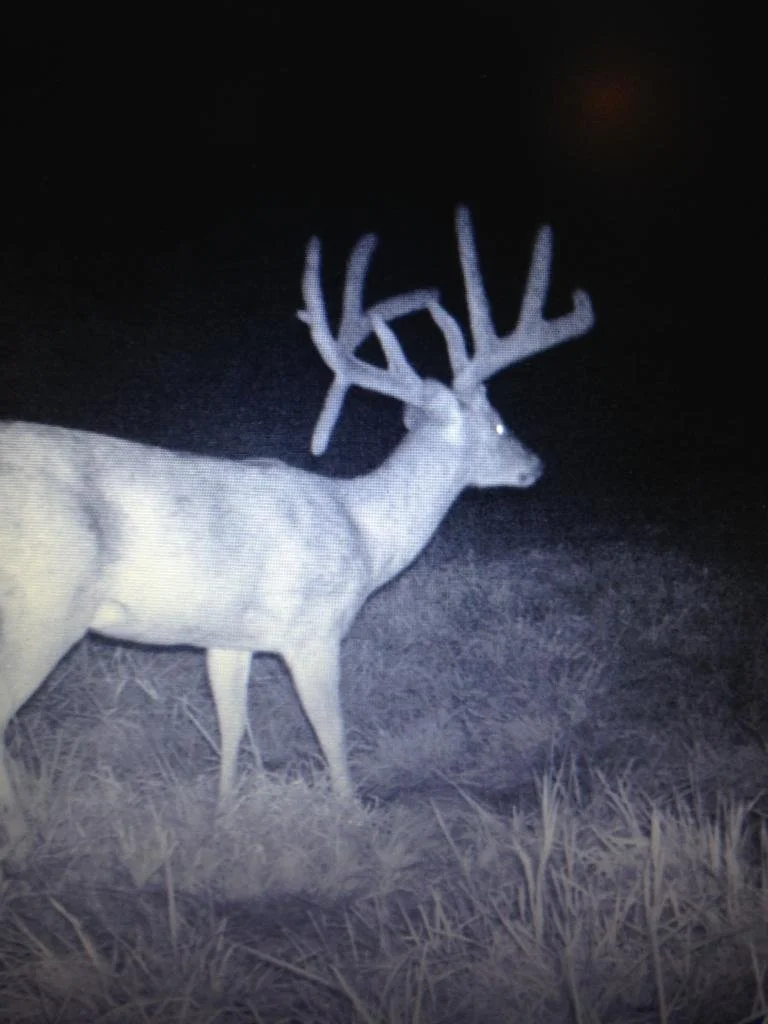
Another buck showed up sometime around the 2013–2016 timeframe and is still one of the most impressive framed deer I’ve ever seen.
He was a gorgeous 8-point. At 4½, he was almost completely clean other than a few bumps on his G2s and was probably somewhere in the upper 140s.
The following year, he added to his frame and was probably in the upper 150s, maybe even pushing 160 inches as essentially a clean 8-point.
I only had access to a small sliver of his range, which was mainly part of his summer range. There were eyewitness reports of him in the neighborhood during November, but I was never really in the game to hunt him. We had other bucks of similar size that were much more centered on the ground we had access to.
Then, before the following season, I made a comment that I still remember:
“That buck is going to throw a giant drop when he reaches 6½.”
I obviously had no way of knowing that. It was just a gut feeling based on his frame and what he had been doing from year to year.
When I went out to pull the first SD card from that particular spot that summer, the first picture was of that buck walking away.
I was blown away.
He had made another huge jump—and hanging off his left side was a brand-new droptine.
He went from a 155–160-inch 8-point to a buck whose typical 4x4 frame I honestly thought might net around 170 inches. That alone would have made him an incredibly special whitetail. Then add a 7- or 8-inch droptine coming off that frame.
At that point, it didn’t matter that we only hunted a sliver of his territory. We knew we had to do whatever we could to make an attempt at a true once-in-a-lifetime deer.
I got his picture a few more times at the beginning of October, but shortly after the first week he disappeared, just as he had in previous years.
As a side note, I run mainly cell cameras now, but I miss the rush of pulling those first SD cards in late summer and taking inventory. Because I run a much more extensive camera game today, I’m rarely completely surprised by a new buck. The constant feed from cell cameras takes away some of that shock we used to get when we pulled a card and had absolutely no idea what was going to be on it.
I miss that.
There’s one more interesting piece to this buck’s story. He didn’t show up the following summer, and I assumed he had probably been killed. But with a deer that big and unique, it’s a small deer world. Those bucks usually surface somehow, and these days it seems like we eventually learn the fate of almost every well-known deer.
Then my brother saw a picture of a buck the following season on Twitter that looked exactly like him.
We did a little research and found that the guy who posted the picture was from the same town. There was no question—it was him.
It was another reminder that even when a buck has summered in the same place year after year, he can shift at any time.
That’s part of what keeps me fascinated with whitetails. Most of them seem to follow some version of an annual pattern, but they’re still wild animals, and all options are on the table.
I never saw a picture of that buck dead. Maybe he eventually died of old age. Maybe another hunter killed him years later after his antlers changed and he lost the drop. Maybe he simply disappeared to natural causes.
I’ll never know.
My First Droptine Buck
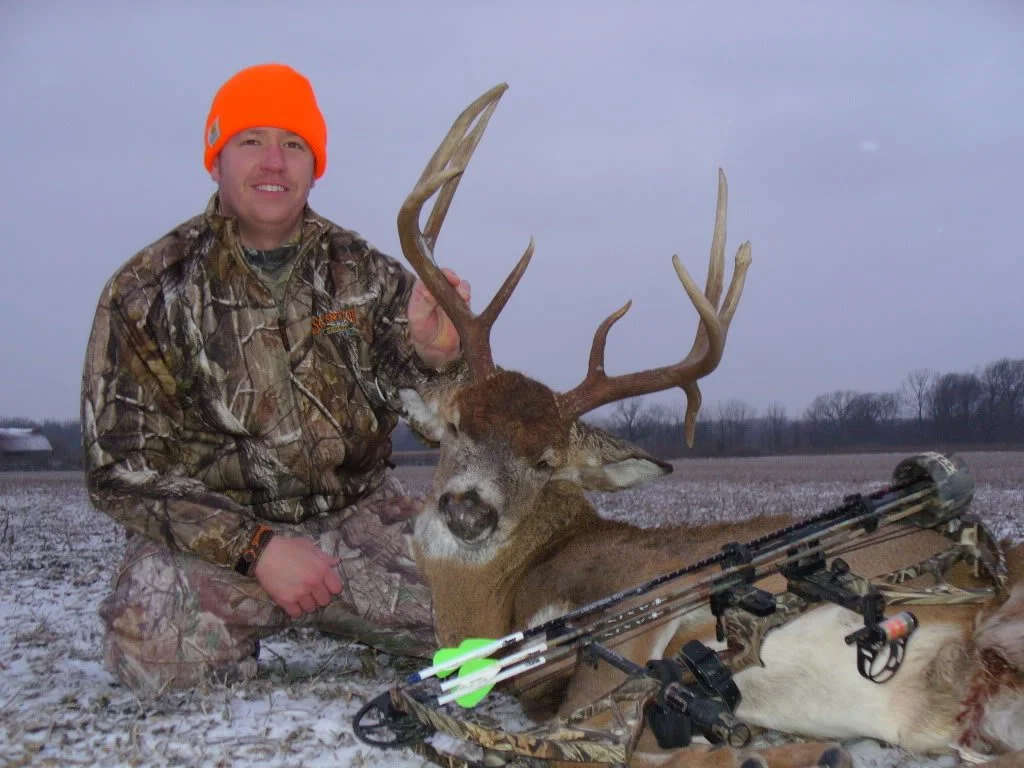
The last droptine buck I’ll talk about was actually the first one I ever encountered, and this was before I had many trail cameras.
I think I saw him once from my vehicle with another buck in early October. The next time I saw him was opening weekend of muzzleloader season.
This deer meant something to me for a number of reasons. I had recently moved back from Iowa and was hunting the area I had grown up hunting after being away for a couple of years.
That day the wind was blowing around 40 mph and the temperature was in the low teens. Brutal conditions.
I spotted the buck from the road, bedded about 80 yards away in a small block of timber. When I slowed down, I noticed him move his head toward my vehicle. I circled the woodlot twice trying to put together some kind of plan.
With the wind and blowing snow, I thought I might actually have a chance to stalk him from the opposite direction.
I was hunting with a bow, so I knew I had to get close. Fortunately, he was bedded with his head pointed away from the direction I would be coming.
I parked about halfway down the road. I hadn’t planned on hunting that evening, so I didn’t even have gloves or proper boots with me, but I knew it was worth a try.
As I stalked closer and closer to where I had last seen him, I became more confident that this might actually work.
Eventually, I got to 22 yards.
What I didn't know at the time was that the buck had been shot through the leg with a bullet. Looking back, I honestly don't think he would have made it through the end of the season.
I was able to put an arrow into him on a hard quartering-away shot. He came out of that bed like he had been shot out of a cannon, stopped about 10 yards away to look back, and tipped over.
It was probably one of the coolest hunts I’ve ever had.
When I walked up to him, I finally got a good look at his rack. I had caught glimpses of it once or twice, but I was never exactly sure what he had going on.
He was a solid buck—a basic 8-point with a roughly 5-inch droptine.
He was the first true droptine buck I had ever seen since I started hunting.
How Long Until the Next One?
Those are the three.
Nearly two decades of cameras, hunting, glassing fields and watching whitetails, and I can still count the true droptine bucks I’ve encountered on one hand.
If I stay on the same trajectory, it might be another seven or ten years before I see another one.
Or maybe I’ll never see another.
Then again, I might pull up a cell-camera picture tomorrow and there one will be.
That's part of what makes them so special—and part of what keeps me fascinated with whitetails after all these years.
You just never know what the next buck is going to grow.