The Buck That Got Me Started
I received my first bow for Christmas when I was 13 years old and went out to the woods over Christmas break for the last two days of the season that year. That technically lit my fire. It was below zero both days, I could barely stay warm, and my toes were frozen, but I was able to hunt a property that had several deer.
The funny thing is, I remember shooting at a yearling doe and shooting right over her back. We talk about buck fever, but man, I'm not sure I've ever had the shakes worse than I did trying to find my peep sight, find the 10-yard pin, and steady it on her lungs. I'm not even sure I waited long enough to get the pin on fur before I hit the release.
Buck fever—or in this case, doe fever—took over.
From that day on, I constantly thought about how and what I was going to do to get a deer with archery tackle. Better yet, a buck. Any buck. Something with antlers.
The following season, I killed a basket-racked 8-point yearling at nearly point-blank range. I've never been so proud of anything, and that deer really started it all. I hunted all through high school, killed a couple more bucks and several does, and had to figure most of it out through trial and error.
Man, those times were fun.
All that being said, I can point to one deer that changed the way I hunted.
The First Buck I Truly Hunted
In 2001—I think—I spent more time scouting during the summer. This was well before I had trail cameras. On my first sit of the year, I went into a spot and set up on the ground.
That evening, a buck I didn't even know existed came in at about 10 yards while I was basically curled up on the ground. The wildest part was that he eventually stood at about 20 yards and snorted more than 20 times before going back into the thicket he had come out of.
He never saw me, but he obviously winded me.
At that point, he was the largest buck I had ever encountered.
Although my knowledge of big bucks was a fraction of what it is today, I believed I would have another chance at him if I could hunt the edge of that thicket.
I was under the old-school way of thinking that a buck beds in the same spot over and over, so in my mind, I could just go back to that edge and eventually get him.
I became obsessed with this buck.
Every sit from that point until the day I finally arrowed him was spent hunting that one deer. It was the first time in my life I was solely trying to harvest one particular buck.
Setting the Trap
That summer, I had gone to a seminar where they promoted synthetic buck urine. My thought was simple: I'll go in under the cover of darkness, make a mock scrape on the edge of his bedding area, and wait him out.
This particular woods was in a semi-urban area amongst houses with quite a bit of human traffic in general, which I think helped me get away with some of what I was doing.
Every time I sat that particular stand, I would doctor the scrape.
Remember, this was before I had trail cameras, so I couldn't check an app and see what was visiting it. But what I did notice was that every time I came back, the scrape had been hit. There were big tracks in it, and several of the trees around it were being rubbed.
In my mind, the trap had been set.
On October 31, I decided to push the wind direction a little bit. Keep in mind, this was 25 years ago and the first time I'd ever really tried to hunt one particular buck.
I doctored the scrape, and the wind was right on the edge of his bedding area. I even used a drag rag with doe-in-estrous scent. Today, I understand a lot more about scent and how quickly some of those pheromones break down once exposed to air. But at the time, what I was trying to simulate was a hot doe and another large buck coming in and working this scrape—which, by this point, was about the size of a car hood.
My plan was for all of that scent to blow back toward where I believed he was bedded.
Looking back, it worked.
Just a little too quickly.
I was still about 50 yards from my stand, trying to get right on the edge so the scent would blow back toward him, when I heard some twigs crack.
Then I caught movement.
It was him.
And he was walking directly toward the scrape.
The problem was, I was caught in an awkward position. I did have a line of sight to where I thought he was going to pop out, though.
Before stepping out of the thicket, he started raking his antlers on some trees at about 50 yards. He then started walking pretty steadily toward the north end of the thicket.
I came to full draw, squeezed the trigger, and watched the arrow fly about one inch underneath his belly, right behind the front leg.
I was instantly sick.
The good news was that it was fairly windy, and he had no idea what had just happened.
He proceeded to walk right into the scrape I had just doctored, thrashed the branches above it, and then went on to make three other scrapes.
As a side note, one lesson I see looking back is that I've probably gotten away from trying some of these same tactics over the years—and they were obviously working.
I sat there and watched him work three scrapes before he went right back into the bedding area he had come from.
And the wild thing?
This was at 3:00 in the afternoon.
I sat huddled there until dark, slid down the backside of the creek bank, and walked the creek out of the woods in the dark.
I was sick.
I had just missed my opportunity.
Everything except the shot had worked almost exactly like I had imagined it would.
And somehow, he had walked away completely unscathed.
November 6
My next opportunity to hunt was November 6.
By this point, I was worried he might be with a doe or on another property, but I still felt confident walking in.
This was going to be a morning hunt, and out of precaution, I got to the woods about two hours before sunrise. I used the drag rag again from the field edge and doctored the scrape in the dark.
At some point, I got a little turned around and accidentally walked about 15 yards past my stand while dragging the rag.
That mistake turned out to be a Godsend.
I sat in my stand for about an hour and a half before I could even see.
Right around sunrise, I saw him coming from the north on the exact trail I had walked in on.
He was moving fairly steadily toward me and appeared to be following the exact path I had taken with the drag rag.
For whatever reason, I still remember this part vividly to this day: I probably had 100 crows around me making all kinds of noise.
The buck—and this was before we started naming every deer for identification—stopped broadside at about 30 yards.
I finally came to full draw, settled the pin...
and watched the arrow sail right over his back.
I couldn't believe it.
But right after the shot, he acted like he had no idea what had happened and started walking directly toward me.
At this point, I was about as nervous and shaken as a hunter could possibly be. I was timing my movements with the trees he walked behind.
And because I had accidentally walked past my tree in the dark with that drag rag, he followed the exact same path.
He stopped broadside 10 yards from the base of my stand.
I was at full draw, and I could feel that buck fever—or maybe just pure anxiety—trying to take over. I remember bringing the pin down and almost punching the trigger when it reached the top of his back.
At the last second, I made the adjustment.
I brought the pin down and watched the arrow disappear right into the 12-ring.
Heart. Double lung.
I heard him run off and was pretty certain I heard a crash, but with my inexperience, I didn't know whether I had actually heard him go down or had just heard him crashing through the brush as he ran.
This was before I had a cell phone, so I climbed down, got in my vehicle, and drove a few miles away to get my dad out of the woods.
About an hour later, we took up the trail.
We walked roughly 80 yards.
And there he was.
I had finally done it.
The Buck That Changed Everything
He was the largest buck I had ever killed, but more importantly, he was the first deer I had ever truly targeted.
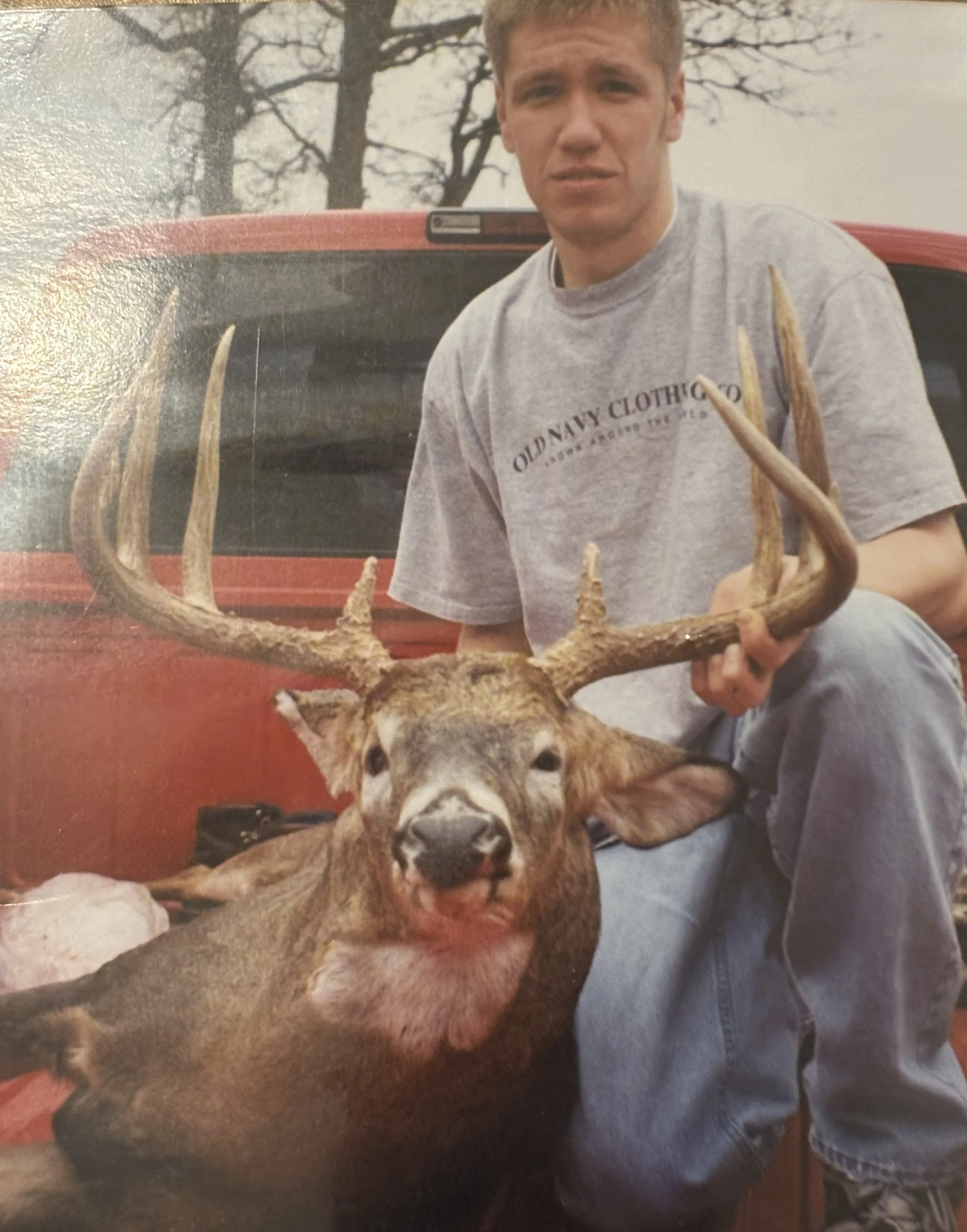
Looking back, I believe the buck was probably five years old. He field dressed at 230 pounds—still one of the heaviest deer I've ever killed—and was a basic 10-point with short G4s that scored 153 inches.
I think that's the only deer I've ever entered and had officially scored to this day, and it probably always will be.
That hunt did two things for me.
First, I felt like I had finally accomplished something I had set out specifically to do. I had a goal. I had a target. And eventually, I got him.
But it also lit a fire that still burns today.
I wanted to do it again.
And again.
I'll post a photo with this story, and it's funny looking at it now. I didn't get some beautiful photo with my bow strategically placed beside me. I'm in the back of a truck.
But that picture is still one of my all-time favorites.
Because that deer meant more to me than almost any of them.
And he still holds a special place for me today.
Looking Back 25 Years Later
It's funny looking back at that season now.
I really didn't have much experience, but I was using tactics that, at the time, made sense to me.
I also pounded that particular spot. But I was meticulous about how I did it.
And yes, I had a ton of luck.
That deer never saw me, and I genuinely don't think he ever knew he was being hunted.
But there were also some things I did right.
I hunted the very edge of where I believed he was bedding. I paid attention to the wind. And one thing that began changing the way I thought about mature bucks was what I noticed during my encounters with him.
He often had the wind in his favor.
But I was setting up right on that edge—close enough to get an opportunity without allowing him to catch me.
I certainly didn't understand all of that then the way I do today.
I had killed bucks before him, and I've killed a lot of bucks since.
But this was the deer that taught me what it felt like to hunt one particular buck.
To scout him. Think about him. Build a plan around him. Make mistakes. Adjust. Go back. And eventually have that plan come together.
That 153-inch 10-point wasn't my first buck.
He isn’t my biggest buck ( was at the time.)
But looking back over all these years, he may have been the most important one.
He was the buck that changed the way I hunted and was the one that made me obsessed with this game to this day.